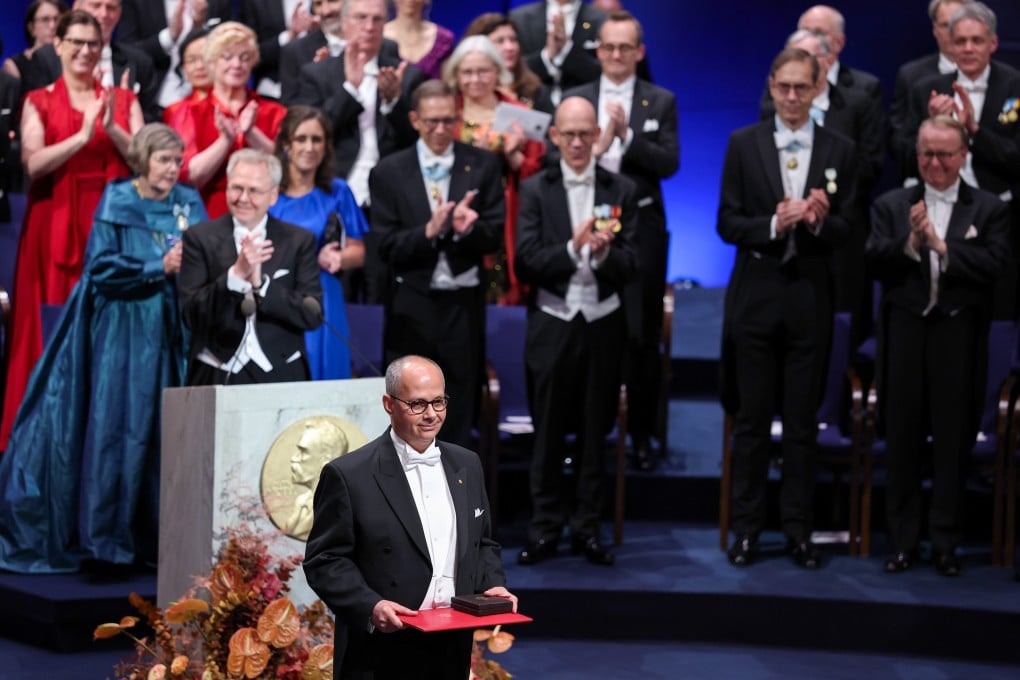
Omar Yaghi
Materials Science
RESEARCH FIELD
Materials Science
Chemistry
Education
State University of New York at Albany
B.S.
Chemistry
,
1985
University of Illinois at Urbana-Champaign
Ph.D
Chemistry
,
1990
Summary
Omar M. Yaghi is a Jordanian-American chemist and the 2025 Nobel Laureate in Chemistry who left the University of California, Berkeley in July 2026 to join Tsinghua University full-time as Chair Professor, leading a new AI-driven materials chemistry research centre in Beijing. He shared the Nobel Prize with Richard Robson and Susumu Kitagawa for pioneering metal-organic frameworks (MOFs), ultra-porous materials capable of capturing carbon, harvesting water from desert air, and storing hydrogen for clean energy.
Born in Amman, Jordan, to a Palestinian refugee family, Yaghi immigrated to the United States at age 15 with limited English, settling in Troy, New York. He earned an associate degree from Hudson Valley Community College in 1983, a B.S. in Chemistry from the State University of New York at Albany in 1985 (cum laude), and a PhD in Chemistry from the University of Illinois at Urbana-Champaign in 1990 under Walter G. Klemperer. After an NSF postdoctoral fellowship at Harvard, he held faculty positions at Arizona State University, the University of Michigan, and UCLA before joining UC Berkeley, where he became the James and Neeltje Tretter Chair Professor of Chemistry and founding director of the Berkeley Global Science Institute.
At Tsinghua, Yaghi heads the newly established AI Chemistry and Materials Research Institute (AIMATRY), aiming to integrate artificial intelligence with materials science to accelerate scientific discovery. He intends to use advanced machine learning to automate and compress the research and development cycles of new materials by as much as tenfold, specifically targeting global challenges including climate change, carbon capture, and clean water shortages. He has said he hopes to develop materials addressing water scarcity, carbon neutrality, and sustainable development, while training young scientists in AI-driven chemistry. Yaghi has trained roughly 200 researchers over his career, nearly half of them Chinese nationals.
Yaghi's decision to relocate was reportedly fueled by growing concerns over declining federal research funding in the United States and the strategic importance of AI-driven chemistry. His move comes at a delicate geopolitical moment, as the United States increasingly restricts joint research initiatives with Chinese institutions while China aggressively invests in drawing elite foreign scholars — a high-stakes migration of top academic talent that has sparked debate over the future of US innovation and funding, and challenges the long-held assumption that the world's leading scientists will always gravitate toward American research institutions.
CURRENT AFFILIATION
Tsinghua University
yaghi@tsinghua.edu.cn