
History Repeating: Lessons from 1930s Germany's Scientist Exodus
How the institutional collapse that drove scientists out of 1930s Germany echoes in today's wave of American researchers heading abroad.
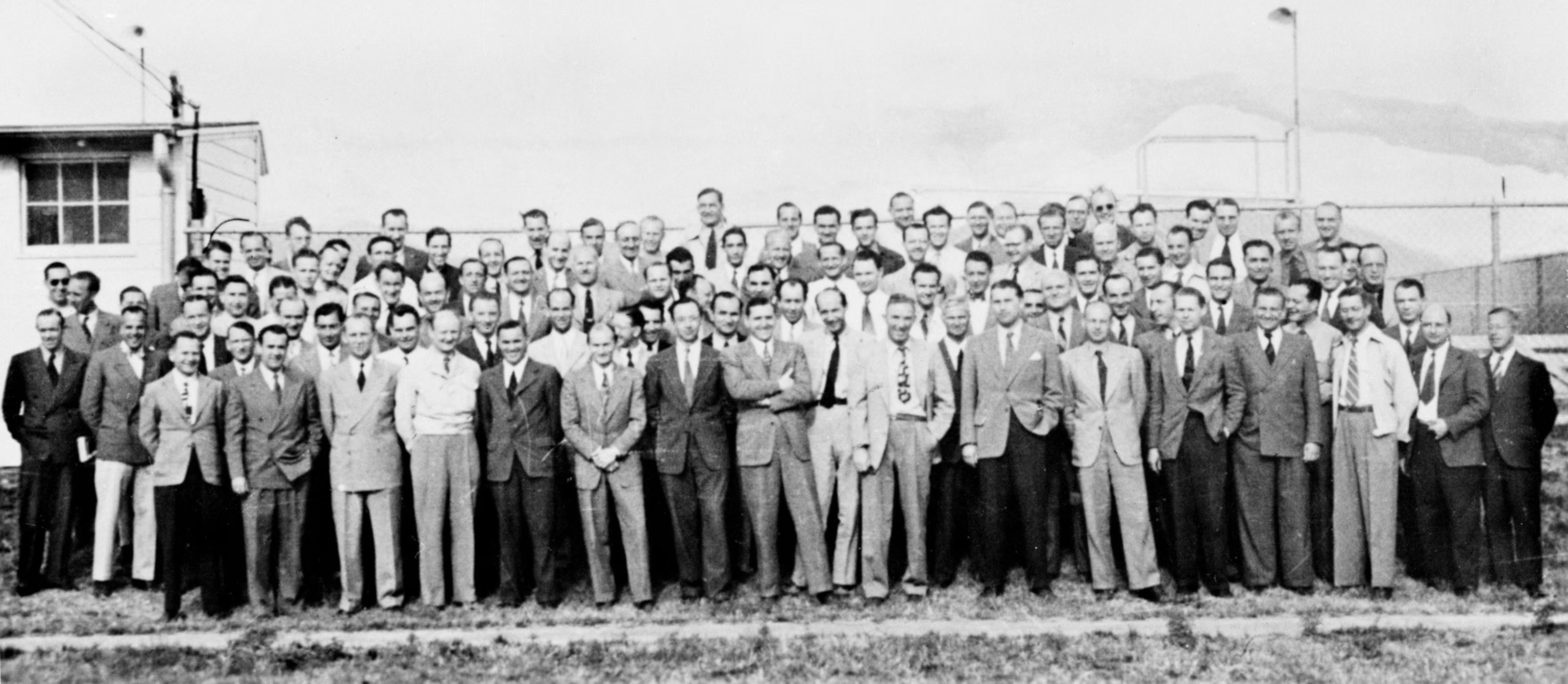
History Repeating: Lessons from 1930s Germany's Scientist Exodus
In the early 1930s, Germany was home to some of the greatest scientific minds on Earth. Within a few short years, many of them were gone, not because their work had failed, but because their government had turned against them. Einstein left. So did dozens of other physicists, chemists, and mathematicians, many of them Jewish, fleeing a regime that had decided their presence was no longer welcome. German science, once the envy of the world, never fully recovered its prewar dominance. The United States, Britain, and other nations were the beneficiaries, a transfer of talent so consequential that historians still study it as one of the great brain gains of the twentieth century.
Nearly a century later, a strikingly similar pattern is unfolding, this time in reverse. The United States, long the world's top destination for scientific talent, is now watching a wave of its own researchers head for the exits. The circumstances are different in almost every particular: no one is being rounded up, no one's life is in danger, and the researchers leaving today are doing so by choice rather than under threat of violence. But the underlying mechanics, political interference in research, funding pulled out from under entire fields, a climate of uncertainty that makes staying feel like a gamble, echo a pattern historians have seen before.
The Mechanism, Then and Now
What made 1930s Germany's brain drain so swift wasn't just persecution, it was the speed with which institutional stability collapsed. Professorships were revoked. Funding vanished overnight. Scientists who had spent decades building their careers suddenly found themselves unable to do their work, regardless of their talent or track record.
Today's departures are being driven by a different but recognizable set of forces: abrupt cuts to federal research funding, grant freezes that leave labs unable to pay their own staff, and a broader sense among many scientists, particularly those born abroad, that the ground beneath their careers is no longer stable.
Where They're Going
In the 1930s, the beneficiaries were the United States and Britain. Today, it's China, Canada, and a cluster of European countries, Austria, France, Germany, and others, that have moved quickly to recruit displaced American talent. Some, like Austria's APART-USA program, were created explicitly in response to this moment, offering funding and positions specifically to researchers leaving US institutions.
Where They're Going
It would be a mistake to treat this comparison as a perfect parallel, and it's worth being honest about that. The scientists who fled Germany in the 1930s were fleeing a campaign of persecution and, for many, an existential threat to their lives. Today's departures are driven by funding instability and policy uncertainty, serious, but categorically different in both scale and stakes. What the two moments share isn't the severity of the threat, but the shape of the response.
That's the real lesson worth sitting with. Brain drains rarely have a single dramatic trigger. They accumulate, one departure at a time, until a country notices it has quietly lost something it assumed was permanent.